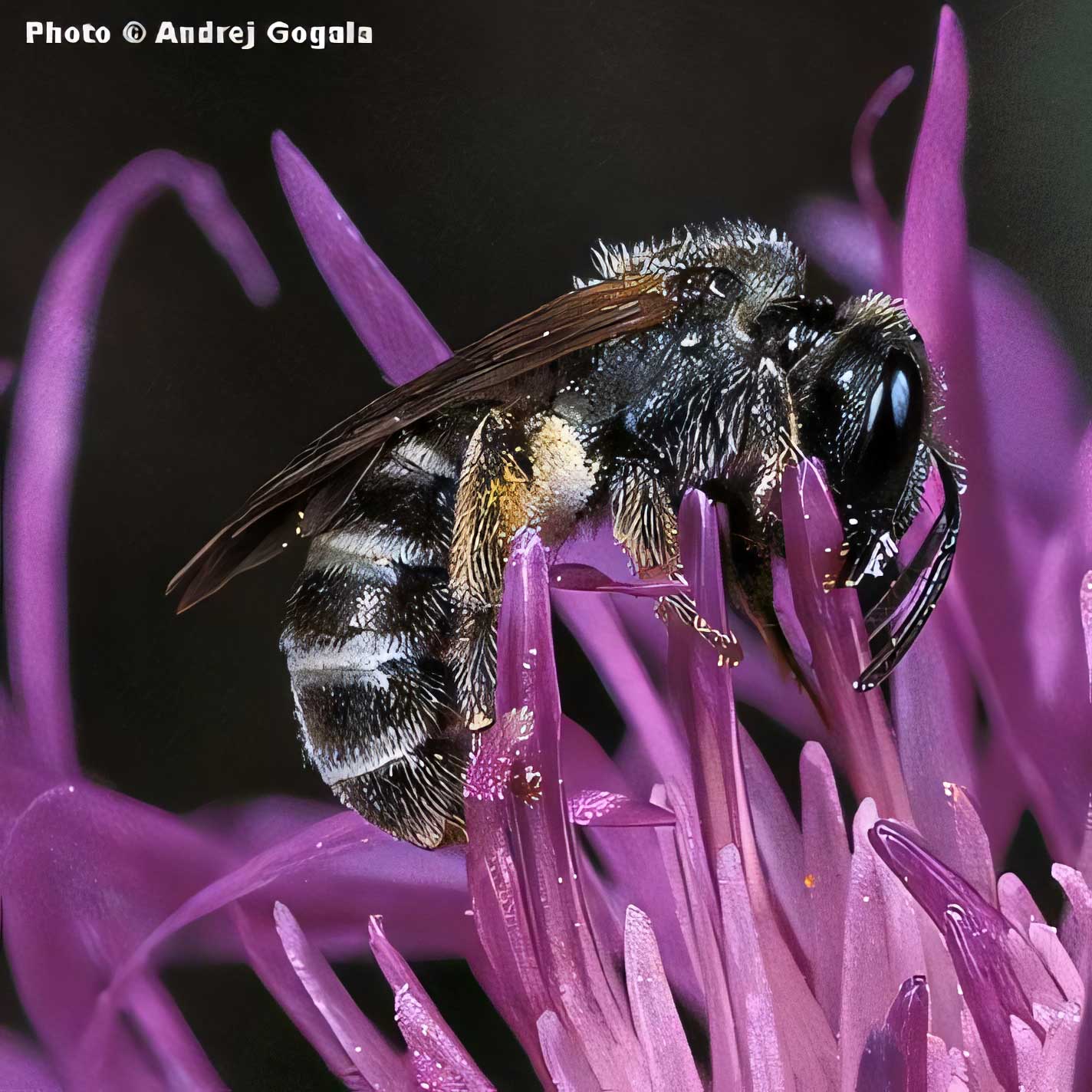
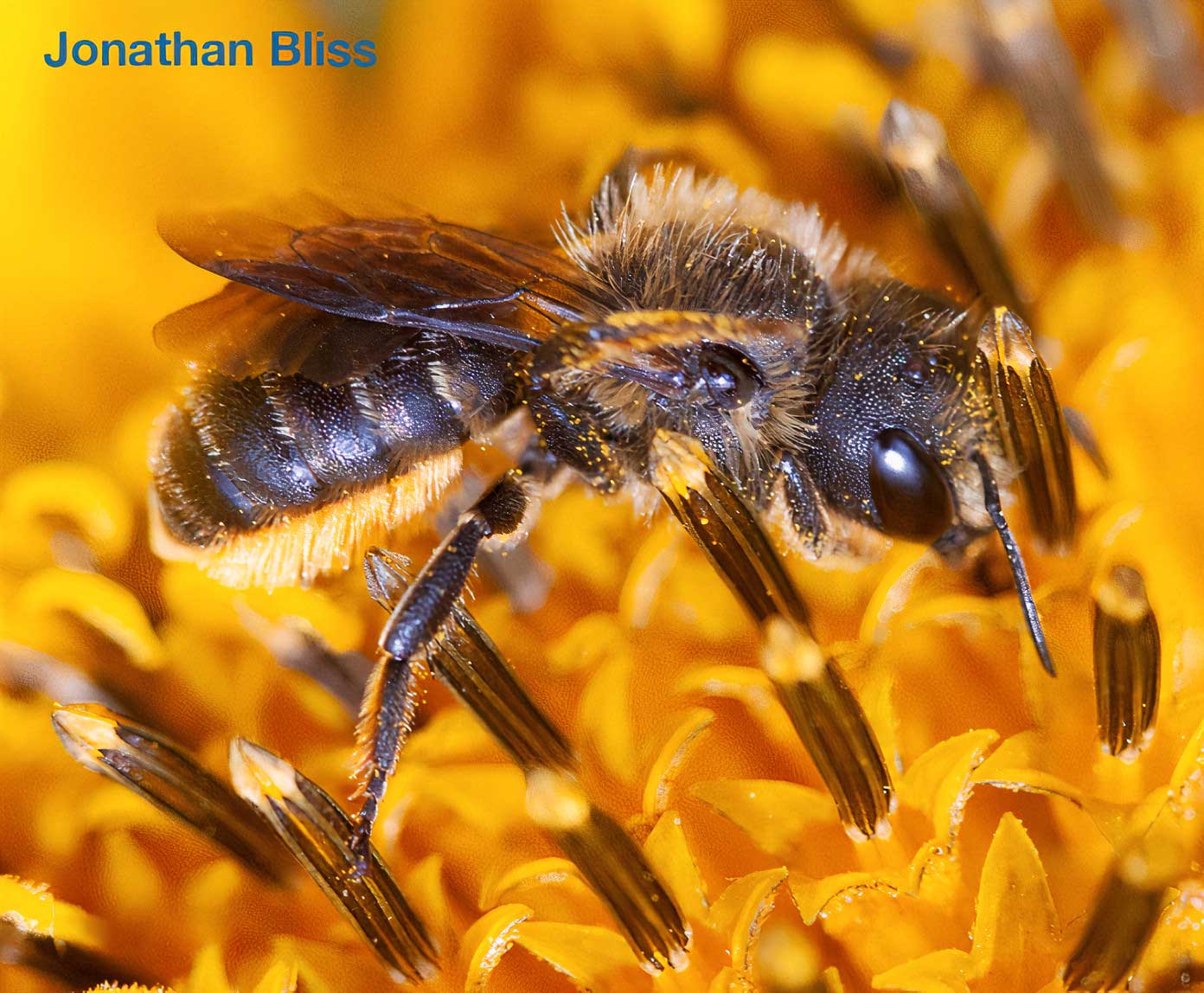
The totems / Plantage
BeeTotem · Plantage, Amsterdam
Mignonette yellow-face bee
Hylaeus signatus
A slender bee with a white and yellow mask that collects pollen only from mignonette. Her Hortus totem stands opposite Artis.
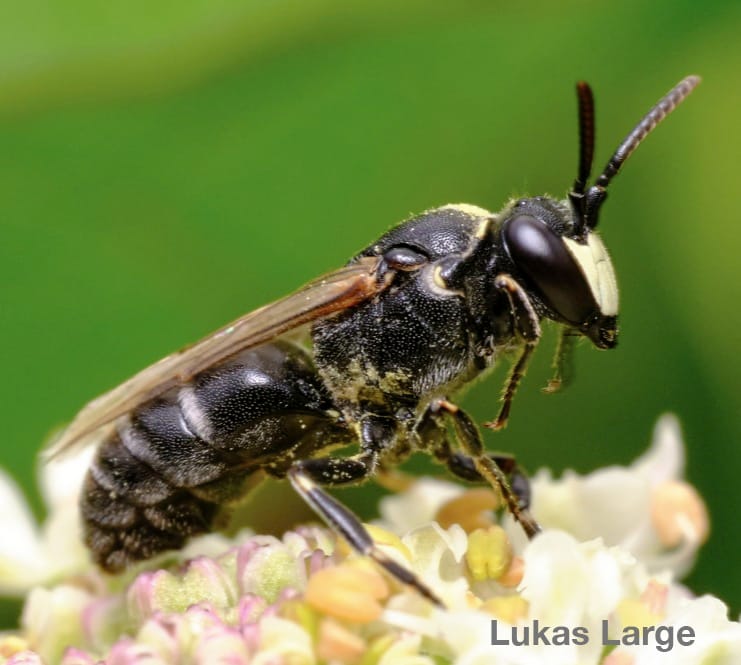 Photo of the bee: Lukas
Bee portrait
A bee that eats from one plant.
The reseda mask bee eats only from reseda and nests in hollow stems. Her totem stands in the Plantage, opposite Artis. Put reseda on your balcony.
Flight time
Late May – AugNests in
Hollow stems and crevicesTotem
PlantageAmsterdamHer plants
6 specieswithin 100 to 300 metresMeet her
The mignonette yellow-face bee in brief.
Appearance
The Mignonette yellow-face bee is a small, slender bee with a shiny black body. You notice the white to yellow patches on the face, especially in the males, which form a typical 'mask'. Unlike many other bees, this species has little hair, so it is sometimes mistaken for a wasp or a fly.
Key traits
The Mignonette yellow-face bee flies from late May to August. She nests in existing cavities, such as hollow plant stems (bramble and rose, for example), old nest tunnels of other insects and cracks in walls, using whatever is available as shelter or brood chamber. She is oligolectic and collects pollen only from plants of the mignonette family, mainly wild mignonette (Reseda lutea) and weld (Reseda luteola)
Did you know?
The Mignonette yellow-face bee depends heavily on specific plants to breed and survive. Because she is oligolectic, she is an indicator species for chalky, flower-rich habitats. Keeping and restoring these habitats is crucial if this bee is to survive.
The totem
Hortus BeeTotem & BeeHotel for the Mignonette Yellow-face Bee
The name 'the Hortus BeeTotem' stands for an important new alliance, in which botanical gardens reach beyond their walls and sow life into the fabric of the city. By creating refuges for wild bees and their plants together with local residents, they encourage communities to become guardians of biodiversity before it disappears for good.
The Mignonette yellow-face bee is also a RefuBee and needs food and shelter. That is why the BeeTotem and BeeHotel were designed specifically for this bee. For the Mignonette yellow-face bee, this means an above-ground BeeHotel with holes 10 cm deep and 3 to 5 mm across, fully waterproof and facing the morning sun in spring. It is made entirely from recycled materials, so it is very sustainable too.
Tiger worms usually make soil rich and fertile, yet Reseda grows on poor, chalky soil. This contradiction creates a tension within this BeeTotem. Still, the worms help the quality of pollen and nectar indirectly: their compost stimulates soil life at a micro level and can strengthen the scents of flowers. The result is a subtle cooperation between scarcity and abundance, working for biodiversity.
The Mignonette yellow-face bee depends heavily on specific plants for food. These plants need to be planted around the BeeTotem to support the bee. It is just as important that hosts and their neighbours grow these plants in their back gardens or on their balconies. That way a network forms in the neighbourhood, the clan of the Mignonette yellow-face bee, in which people actively help to protect this threatened species.
In a city where people often want things neat and tidy, it helps to realise that nature can thrive when we leave room for some wildness. That asks for a different attitude, and for practical changes. The plants the Mignonette yellow-face bee forages on do best on chalky, dry and poor soil. You can encourage this easily by adding crushed shells, eggshells or limestone to the soil.


Where to find her
Westermanplantsoen, Plantage, opposite Artis, Amsterdam-Centrum
52.36561° N, 4.91266° O
Open in the map →What she eats
Her plants, from spring to autumn.
Plant one of these within 300 metres of the totem, and your balcony or garden becomes part of her habitat. The calendar shows when there is something to eat.

More about this plant
- Setting
- Sunny
- Size
- 30–100 cm
- Flowering
- June – September
- Lifespan
- Biennial
- Soil
- Chalky, dry, poor

More about this plant
- Setting
- Sunny
- Size
- 50–120 cm
- Flowering
- June – August
- Lifespan
- Biennial
- Soil
- Chalky, dry, poor

More about this plant
- Setting
- Sunny
- Size
- 30–60 cm
- Flowering
- June – September
- Lifespan
- Annual
- Soil
- Slightly chalky, free-draining

More about this plant
- Setting
- Sunny
- Size
- 40–100 cm
- Flowering
- June-October
- Lifespan
- Annual/biennial
- Soil
- Chalky, dry, stony

More about this plant
- Setting
- Sun
- Size
- 30–60 cm
- Flowering
- June – September
- Lifespan
- Perennial
- Soil
- Chalky, dry, poor

More about this plant
- Setting
- Sunny
- Size
- 30–100 cm
- Flowering
- June – September
- Lifespan
- Perennial
- Soil
- Chalky, moderately moist
Buying plants
Organic, and native if you can.
We share the dream of a number of organic growers: more biodiversity, with flowering native plants for animals and people. Please note: plant availability can vary with the season and the supplier. Wild bees fly at different times of year, usually depending on when the flowers they visit are in bloom. You can order plants and seeds and have them delivered to your home by post. Below you will find suppliers of plants and seeds.
Buy before or at the start of the flowering season. Sowing works too.
Karmagotchi
How the totem is doing.
The Karmagotchi is based on the idea of the Tamagotchi. It is a tool that lets hosts keep track, together, of how the plants and worms in the BeeTotem are doing. A script linked to the local weather station runs all the time, collects temperature and rainfall data and sets the level from 100 to 0%. Hosts have access to this interface. After adding water or kitchen scraps, they can let all the other hosts know by simply tapping the water or food icon.
Water72%
Food for the worms38%
Sample values. Hosts see the real levels here and report with one tap that they have given water or kitchen scraps.
Join in
Help look after the mignonette yellow-face bee.
Host
Become a host of the totem
Hosts feed the worms kitchen scraps, keep the plants watered and tell the neighbours about it. Fill in the covenant and email it to info@refubees.org.
Read the covenantAdopt
Plant her flowers at home
Find out which bee belongs to your neighbourhood and which flowers she needs. One plant on your balcony already helps.
Adopt a beeSpotting
Seen her? Take a photo
The paving stone next to the totem has a QR code that leads to this page. Seen the bee? Take a photo and send it in: that way we can tell whether the totem works.
Send a photoOther totems