The totems / Jordaan
BeeTotem · Jordaan, Amsterdam
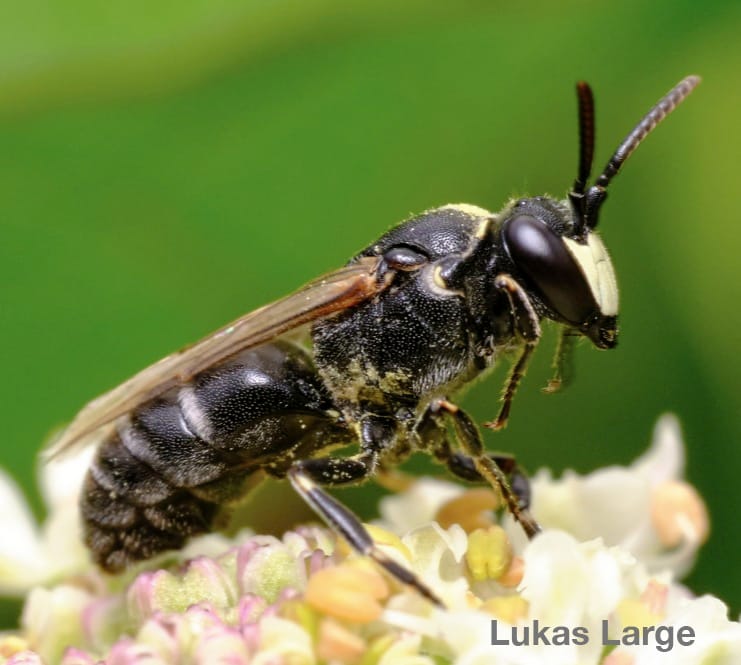
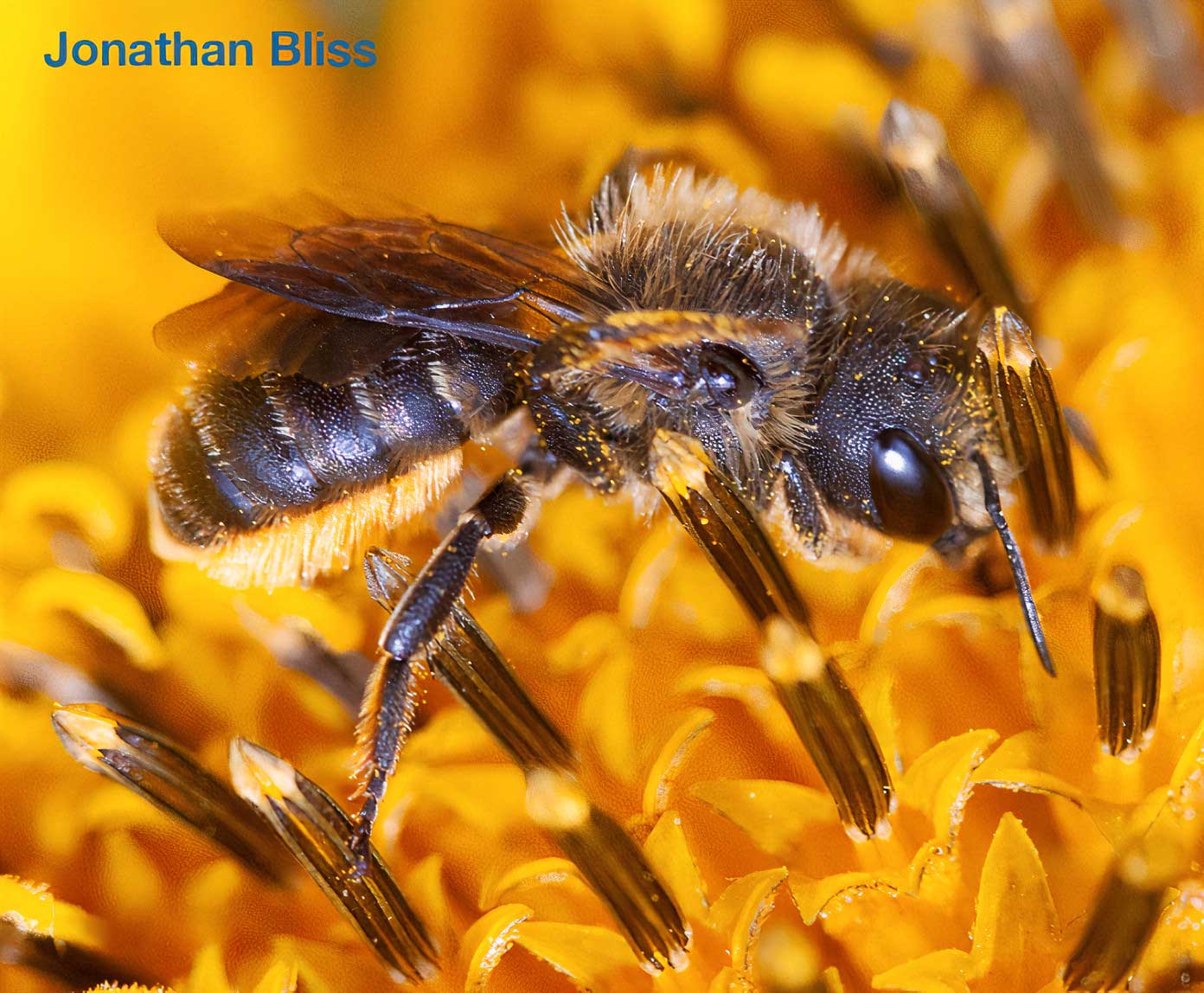
Bronze furrow bee
Halictus tumulorum
One of the most common wild bees in the Netherlands, and yet hardly ever noticed. Her totem stands on the Palmgracht, with the first underground bee hotel in the city centre.
Flight time
May – OctNests in
UndergroundTotem
JordaanAmsterdamHer plants
29 specieswithin 100 to 300 metresMeet her
The Bronze furrow bee at a glance.
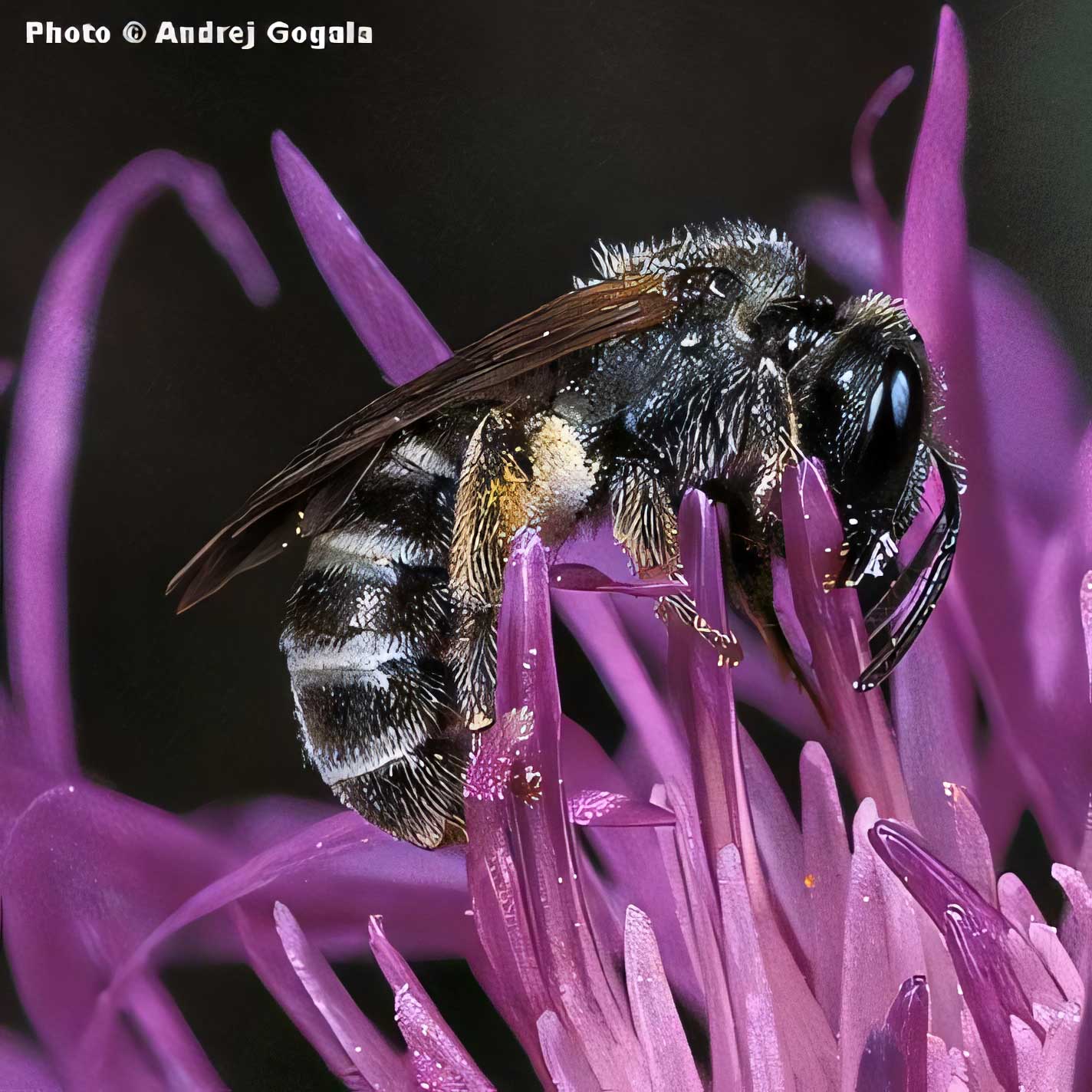
Appearance
First hair band broken. Faint metallic sheen.
Key traits
These are fairly small bees with long, slender tongues. Flight period: May to October. Nest choice: underground. She needs sodium to stay healthy and can "lick" sweat from human skin.
Did you know?
The Bronze furrow bee is hard to recognise because it is so small, but it is one of the most common wild bees in this country. Its success comes from how easily it adapts to different habitats, nest sites and plants. Unlike many other wild bees, she is a generalist. What sets this bee apart is her social behaviour. Wild bees usually live alone, but in warm climates this species works together in small groups. About 4 to 5 unmated females stay in their mother’s nest and help raise the young.
The totem
BEETOTEM AND BEEHOTEL FOR THE BRONZE FURROW BEE
The RefuBee needs food and shelter. Each BeeTotem and BeeHotel is made for one particular bee. For the Bronze furrow bee this means a BeeHotel underground. It is the first artificial underground bee hotel in the centre of Amsterdam, and possibly even in the Netherlands. More than two thirds of all Dutch wild bee species nest underground.
The BeeTotem holds the plants (see below) that this bee feeds on and pollinates. The hosts are a growing group of people who look after the objects with simple rituals. They feel inspired to put the same plants on their balconies and in their front and back gardens, so there is enough food. A clan forms, the ‘Bronze furrow bee clan’, to keep this species from dying out.


Where to find her
Opposite Palmgracht 75, Jordaan, Amsterdam Centre
52.38176° N, 4.88249° O
Open in the map →What she eats
Her plants, from spring to autumn.
Plant one of these within 300 metres of the totem, and your balcony or garden becomes part of her habitat. The calendar shows when there is something to eat.

More about this plant
- Setting
- Sunny
- Size
- 120cm
- Placement
- A
- Platform
- 5
- Flowering
- June-August
- Lifespan
- Perennial
- Soil
- Ruderal

More about this plant
- Setting
- Sunny
- Size
- 45 cm
- Placement
- B
- Platform
- 1
- Flowering
- Spring-Summer
- Lifespan
- Perennial
- Soil
- Clay

More about this plant
- Setting
- Sunny
- Size
- 20-60 cm
- Placement
- F
- Platform
- 5
- Flowering
- April-September
- Lifespan
- Perennial
- Soil
- Ruderal

More about this plant
- Setting
- Sunny
- Size
- 60-120cm
- Placement
- D
- Platform
- 1
- Flowering
- July-September
- Lifespan
- Perennial
- Soil
- Ruderal

More about this plant
- Setting
- Sunny
- Size
- 30-60cm
- Placement
- E
- Platform
- 1
- Flowering
- June-September
- Lifespan
- Annual
- Soil
- Low in lime

More about this plant
- Setting
- Partial shade
- Size
- 10-40 cm
- Placement
- G
- Platform
- 4
- Flowering
- May-June
- Lifespan
- Perennial
- Soil
- Nutrient-rich

More about this plant
- Setting
- Sunny
- Size
- 20-60 cm
- Placement
- H
- Platform
- 2
- Flowering
- June-September
- Lifespan
- Perennial
- Soil
- Nutrient-rich
More about this plant
- Setting
- Sunny
- Size
- 25-40cm
- Placement
- I
- Platform
- 2
- Flowering
- May-October
- Lifespan
- Annual
- Soil
- Field

More about this plant
- Setting
- Sunny
- Size
- 20-50cm
- Placement
- J
- Platform
- 3
- Flowering
- June-September
- Lifespan
- Annual
- Soil
- Field

More about this plant
- Setting
- Moist/partial shade
- Size
- 30-120 cm
- Placement
- K
- Platform
- 4
- Flowering
- June-Oct
- Lifespan
- Biennial
- Soil
- Nutrient-rich

More about this plant
- Setting
- Wet
- Size
- 60-90 cm
- Placement
- L
- Platform
- 5
- Flowering
- July-September
- Lifespan
- Perennial
- Soil
- Brackish

More about this plant
- Setting
- Sunny
- Size
- 30-80cm
- Placement
- M
- Platform
- 5
- Lifespan
- Annual
- Soil
- Clay

More about this plant
- Setting
- Partial shade
- Size
- 20-50cm
- Placement
- N
- Platform
- 4
- Flowering
- April-May
- Lifespan
- Perennial
- Soil
- Any

More about this plant
- Setting
- Sunny
- Size
- 15-60 cm
- Placement
- O
- Platform
- 1
- Flowering
- July-September
- Lifespan
- Woody dwarf shrub
- Soil
- Ruderal

More about this plant
- Setting
- Sunny
- Size
- 30-90 cm
- Placement
- P
- Platform
- 4
- Flowering
- June-November
- Lifespan
- Annual or biennial
- Soil
- Nutrient-rich

More about this plant
- Setting
- Any
- Size
- 30-70cm
- Placement
- Q
- Platform
- 3
- Flowering
- June-September
- Lifespan
- Perennial
- Soil
- Any

More about this plant
- Setting
- Sunny
- Size
- 60-120 cm
- Placement
- R
- Platform
- 3
- Flowering
- June-August
- Lifespan
- Perennial
- Soil
- Clay

More about this plant
- Setting
- Sunny
- Size
- 30-60 cm
- Placement
- S
- Platform
- 3
- Flowering
- May-August
- Lifespan
- Perennial
- Soil
- Moderately nutrient-rich

More about this plant
- Setting
- Partial shade
- Size
- 15-50cm
- Placement
- T
- Platform
- 2
- Flowering
- June-August
- Lifespan
- Perennial
- Soil
- Nutrient-rich

More about this plant
- Setting
- Partial shade
- Size
- 5-40cm
- Placement
- U
- Platform
- 4
- Flowering
- March-May / Sept -Nov
- Lifespan
- Perennial
- Soil
- Nutrient-rich

More about this plant
- Setting
- Partial shade
- Size
- 20-50 cm
- Placement
- V
- Platform
- 4
- Flowering
- June-October
- Lifespan
- Annual or biennial
- Soil
- Nutrient-rich

More about this plant
- Setting
- Sunny
- Size
- 30-90 cm
- Placement
- W
- Platform
- 5
- Flowering
- April-October
- Lifespan
- Perennial
- Soil
- Nutrient-rich

More about this plant
- Setting
- Sunny
- Size
- 60-120cm
- Placement
- X
- Platform
- 5
- Flowering
- July-August
- Lifespan
- Biennial
- Soil
- Nutrient-rich

More about this plant
- Setting
- Sunny
- Size
- 10-60cm
- Placement
- C
- Platform
- 5
- Flowering
- July-September
- Lifespan
- Annual
- Soil
- Clay

More about this plant
- Setting
- Sunny
- Size
- 30-150 cm
- Placement
- Y
- Platform
- 2
- Flowering
- July-October
- Lifespan
- Biennial
- Soil
- Nutrient-rich

More about this plant
- Setting
- Sunny
- Size
- 5-25 cm
- Placement
- Z
- Platform
- 5
- Flowering
- May-October
- Lifespan
- Perennial
- Soil
- Nutrient-rich

More about this plant
- Setting
- Sunny
- Size
- 10-45cm
- Placement
- AA
- Platform
- 1
- Flowering
- June-August
- Lifespan
- Biennial/perennial
- Soil
- Ruderal

More about this plant
- Setting
- Partial shade
- Size
- 60-90cm
- Placement
- BB
- Platform
- 4
- Flowering
- June-July
- Lifespan
- Perennial
- Soil
- Nutrient-rich

More about this plant
- Setting
- Sunny
- Size
- 30-75 cm
- Placement
- CC
- Platform
- 5
- Flowering
- June-September
- Lifespan
- Annual or biennial
- Soil
- Nutrient-rich
Extra: not native, but much loved

More about this plant
- Setting
- Sunny
- Size
- 10-50cm
- Flowering
- June-October
- Lifespan
- Annual

More about this plant
- Setting
- Sunny
- Size
- 40-50 cm
- Flowering
- June-September
- Lifespan
- Perennial
Buying plants
Organic, and native if you can.
We share Cruydt-Hoeck’s dream of creating more biodiversity with flower-rich vegetation for plants, animals and people. Cruydt-Hoeck is an organic grower and supplier of native wild plants and wild plant seeds. You can order plants and seeds online and have them delivered to your door.
Buy before or at the start of the flowering season. Sowing works too.
Karmagotchi
How the totem is doing.
The Karmagotchi is based on the idea of the Tamagotchi. It is a tool that lets hosts keep track, together, of how the plants and worms in the BeeTotem are doing. A script linked to the local weather station runs all the time, collects temperature and rainfall data and sets the level from 100 to 0%. Hosts have access to this interface. After adding water or kitchen scraps, they can let all the other hosts know by simply tapping the water or food icon.
Water72%
Food for the worms38%
Sample values. Hosts see the real levels here and report with one tap that they have given water or kitchen scraps.
Join in
Help look after the bronze furrow bee.
Host
Become a host of the totem
Hosts feed the worms kitchen scraps, keep the plants watered and tell the neighbours about it. Fill in the covenant and email it to info@refubees.org.
Read the covenantAdopt
Plant her flowers at home
Find out which bee belongs to your neighbourhood and which flowers she needs. One plant on your balcony already helps.
Adopt a beeSpotting
Seen her? Take a photo
The paving stone next to the totem has a QR code that leads to this page. Seen the bee? Take a photo and send it in: that way we can tell whether the totem works.
Send a photoOther totems