The totems / Leiden
BeeTotem · Stationsbuurt, Leiden
Ivy bee
Colletes hederae
She only flies in autumn and lives almost entirely on ivy. Her totem stands near Leiden Centraal station, with a bee hotel for ground-nesting bees.

Flight time
Aug – NovNests in
In the groundTotem
LeidenLeidenHer plants
19 specieswithin 100 to 300 metresMeet her
The ivy bee in brief.
Appearance
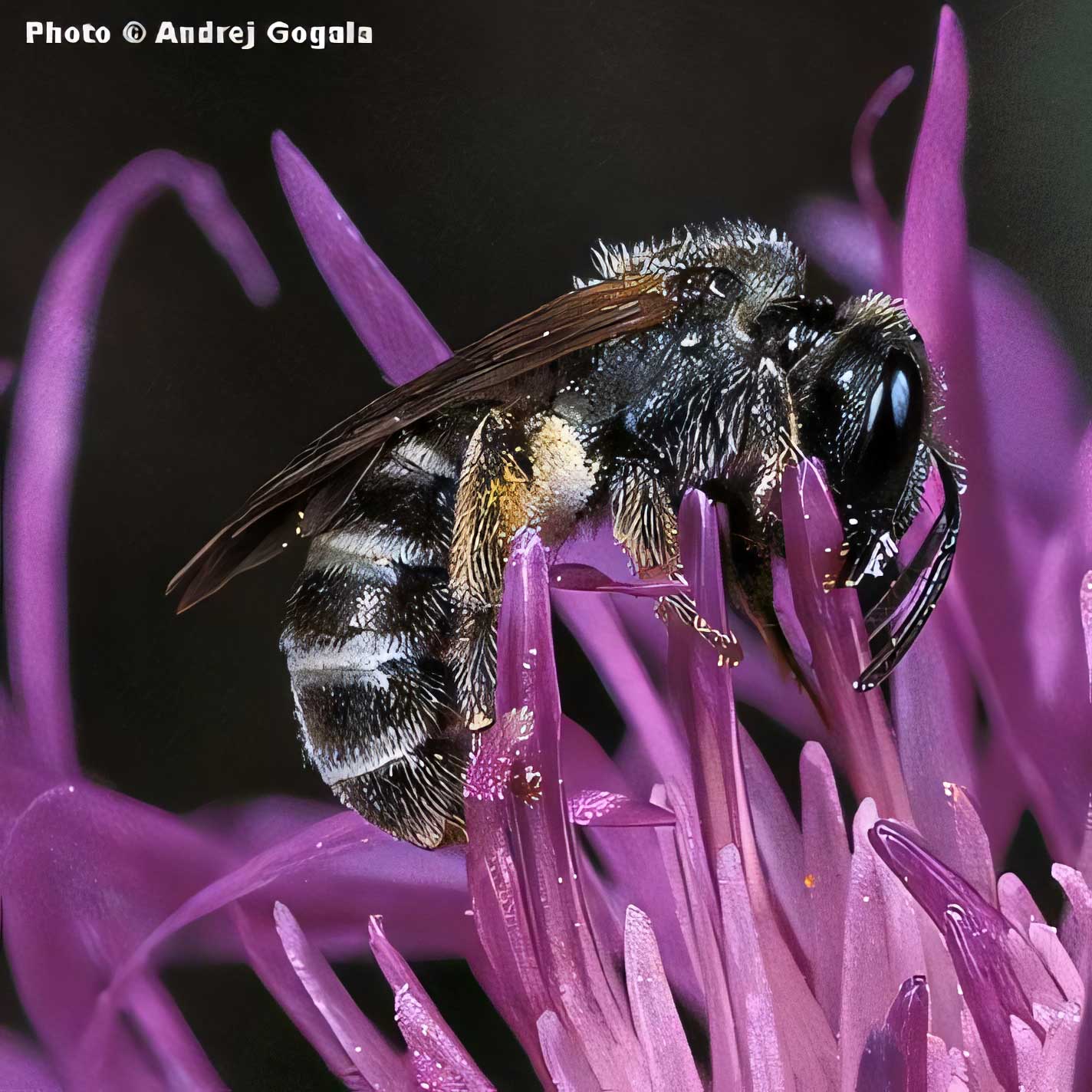
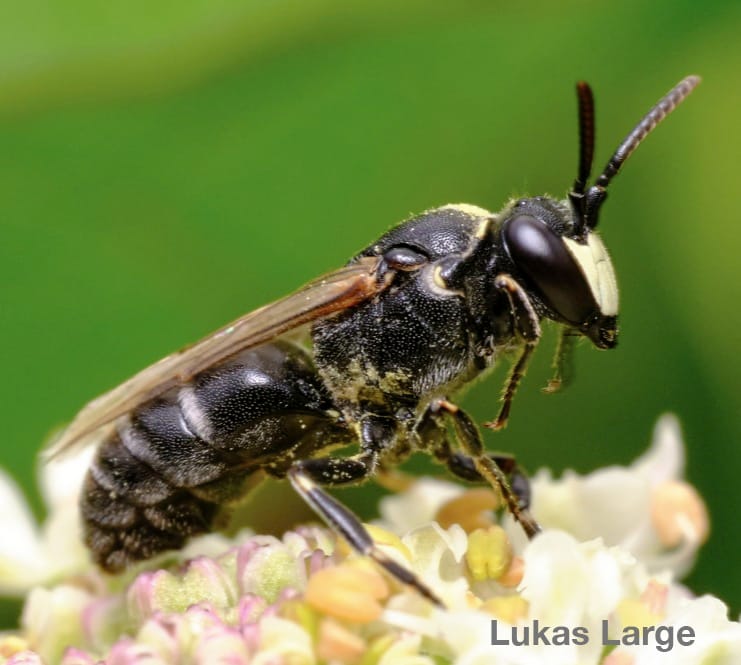
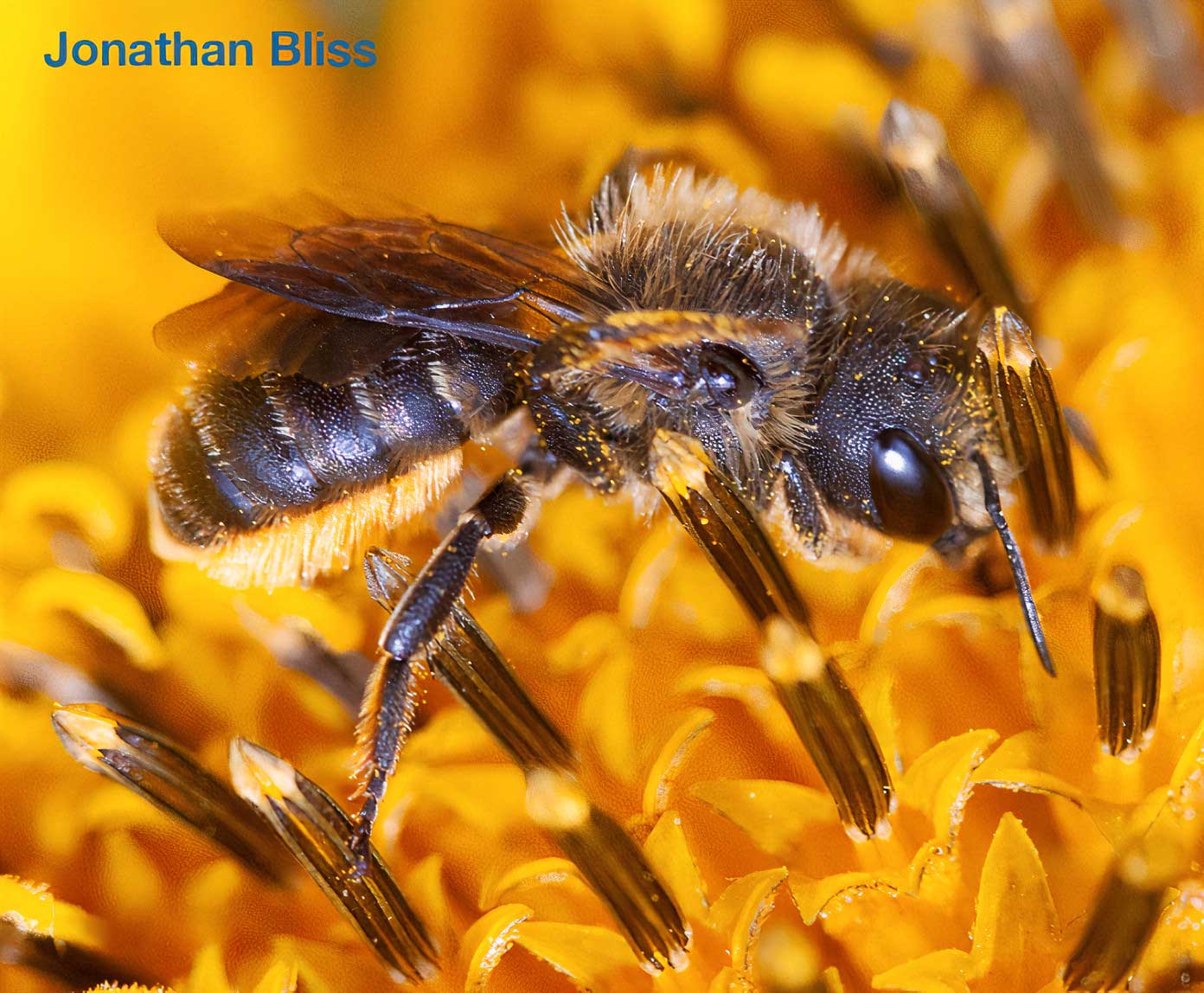
The ivy bee is a medium-sized solitary bee with a warm, reddish thorax and striking orange-yellow bands on the abdomen, which make her more colourful than many of her relatives. Females are slightly larger and hairier, and are often mistaken for small honey bees.
Special features
This bee has only one generation a year. Males appear at the end of August, followed by females in September. Both stay active into November. They prefer sandy or loamy soil on sunny banks, lawns or even cliffs, and often form huge nesting colonies with thousands of separate nest tunnels.
Did you know?
The ivy bee is highly specialised and lives almost entirely on ivy (Hedera helix) for pollen and nectar, timed exactly to the late flowering of ivy in autumn. When ivy is scarce, she sometimes visits other composite flowers. In the Netherlands the species was first recorded in Maastricht in 1997. She is also parasitised by the blister beetle Stenoria analis, whose larvae mimic female pheromones to lure males: a remarkable bit of trickery in nature.
The totem
BeeTotem & BeeHotel for the ivy bee
The BeeTotem for the ivy bee is a luxury restaurant full of power food. It works on circular principles: in the core of the BeeTotem, worms make nourishing 'cocktails' from kitchen scraps brought by hosts. Through small tunnels the worms crawl into the soil and enrich it with compost.
This can have two effects. The pollen and nectar for the larvae become more nourishing, so the young bees grow stronger and more resilient, which may lead to a healthier generation the following year. At the same time the plants send out stronger signals, so they attract pollinators from further away.
Because ivy bees nest in the ground, a BeeHotel for ground-nesting species has been placed close by. Together, BeeTotem and BeeHotel form a complete habitat: food and shelter side by side.
By planting important ivy species on a large scale (Hedera helix arborescens and Hedera colchica), together with other plants that flower at different times and give pollen and nectar to ivy bee males, a tailor-made habitat grows in the neighbourhood. There is still a lot to discover, though.


Where to find her
Marislaan, corner of Aloëlaan, Maredijkbuurt, Leiden
52.16663° N, 4.48705° O
Open in the map →What she eats
Her plants, from spring to autumn.
Plant one of these within 300 metres of the totem, and your balcony or garden becomes part of her habitat. The calendar shows when there is something to eat.

More about this plant
- Setting
- Sun–shade
- Size
- Up to 25 m
- Flowering
- September–November
- Lifespan
- 100+ years
- Soil
- humus-rich, moist, free-draining soil

More about this plant
- Setting
- Sun–shade
- Size
- Up to 2 m
- Flowering
- September–November
- Lifespan
- Perennial
- Soil
- Humus-rich, moist, free-draining soil

More about this plant
- Setting
- Sun–shade
- Size
- Up to 4 m
- Flowering
- July–October
- Lifespan
- Perennial
- Soil
- pH neutral to alkaline, fertile, well drained

More about this plant
- Setting
- Sunny, grassland
- Size
- 20–50 cm
- Flowering
- July–October
- Lifespan
- Annual
- Soil
- Dry, chalky, poor

More about this plant
- Setting
- Sunny
- Size
- 20–50 cm
- Flowering
- July–September
- Lifespan
- Perennial
- Soil
- Acid, poor, sandy

More about this plant
- Setting
- Sun to partial shade
- Size
- 30–100 cm
- Flowering
- August – October
- Lifespan
- Perennial
- Soil
- moderately dry to moist, moderately nutrient-rich

More about this plant
- Setting
- Sunny
- Size
- 1–2 m
- Flowering
- August–October
- Lifespan
- Perennial
- Soil
- Nutrient-rich, moist to dry

More about this plant
- Setting
- Sun to partial shade
- Size
- 10–30 cm
- Flowering
- September–October
- Lifespan
- Perennial
- Soil
- Moist, chalky, grassland

More about this plant
- Setting
- Sun
- Size
- Shrub/tree, 5–10 m
- Flowering
- July–August
- Lifespan
- Perennial, shrub/tree
- Soil
- Well drained, moderately nutrient-rich

More about this plant
- Setting
- Sun to partial shade
- Size
- 10–50 cm
- Flowering
- May–October
- Lifespan
- Perennial
- Soil
- Moderately dry to moist, poor

More about this plant
- Setting
- Sun
- Size
- 10–60 cm
- Flowering
- June–October
- Lifespan
- Perennial
- Soil
- Dry to moist, moderately nutrient-rich

More about this plant
- Setting
- Sunny, coastal dunes
- Size
- 20–60 cm
- Flowering
- June–August
- Lifespan
- Perennial
- Soil
- Sandy, chalky, free-draining

More about this plant
- Setting
- Sunny, edges
- Size
- 30–80 cm
- Flowering
- July–September
- Lifespan
- Perennial
- Soil
- Dry, chalky, poor to moderate

More about this plant
- Setting
- Sunny
- Size
- 30–80 cm
- Flowering
- May–October
- Lifespan
- Perennial
- Soil
- Dry, stony, chalky

More about this plant
- Setting
- Sunny, grassland
- Size
- 30–80 cm
- Flowering
- June–September
- Lifespan
- Perennial
- Soil
- Dry, chalky, sandy

More about this plant
- Setting
- Sun
- Size
- 100–150 cm
- Flowering
- August–October
- Lifespan
- Perennial
- Soil
- Nutrient-rich, moist

More about this plant
- Setting
- Sunny
- Size
- 50–150 cm
- Flowering
- June–September
- Lifespan
- Biennial, long-lived
- Soil
- Rather dry, nitrogen-rich

More about this plant
- Setting
- Sun–partial shade
- Size
- 5–20 cm
- Flowering
- May–October
- Lifespan
- Perennial
- Soil
- Moist, nutrient-rich, lawns

More about this plant
- Setting
- Sun–partial shade
- Size
- 30–80 cm
- Flowering
- June–September
- Lifespan
- Perennial
- Soil
- Moist, moderately nutrient-rich
Buying plants
Organic, and native if you can.
We now know that we should feed pollinators with non-toxic, organic plants. As a result, more and more nurseries grow organically. We share the vision of growers who work with local and native genotypes to support biodiversity in their eco-zone and to contribute to nature conservation worldwide. Please bear in mind that plant availability depends on the season and the supplier. Your best chance of success is to buy before or at the start of each flowering season (see above). Sowing seeds is also an option. There are several places where you can order organic plants and seeds, which are then delivered by post. Some suppliers are listed below.
Buy before or at the start of the flowering season. Sowing works too.
Karmagotchi
How the totem is doing.
The Karmagotchi is based on the idea of the Tamagotchi. It is a tool that lets hosts keep track, together, of how the plants and worms in the BeeTotem are doing. A script linked to the local weather station runs all the time, collects temperature and rainfall data and sets the level from 100 to 0%. Hosts have access to this interface. After adding water or kitchen scraps, they can let all the other hosts know by simply tapping the water or food icon.
Water72%
Food for the worms38%
Sample values. Hosts see the real levels here and report with one tap that they have given water or kitchen scraps.
Join in
Help look after the ivy bee.
Host
Become a host of the totem
Hosts feed the worms kitchen scraps, keep the plants watered and tell the neighbours about it. Fill in the covenant and email it to info@refubees.org.
Read the covenantAdopt
Plant her flowers at home
Find out which bee belongs to your neighbourhood and which flowers she needs. One plant on your balcony already helps.
Adopt a neighbourhood bee in South HollandSpotting
Seen her? Take a photo
The paving stone next to the totem has a QR code that leads to this page. Seen the bee? Take a photo and send it in: that way we can tell whether the totem works.
Send a photoOther totems