What is RefuBees / Art and science
Art and science
Art and Science
Art and science form a dynamic interplay that underlines the importance of their collaboration in promoting inventive methods in both domains.

Interdisciplinary collaboration
broadening horizons and mutual enrichment
The TU Delft Urban Ecology Lab places great emphasis on interdisciplinary collaboration. This approach serves two essential purposes. First, it broadens participants’ conceptual horizons by bringing them into contact with different ideas and people they would not normally encounter. Second, it promotes cross-pollination between different fields, such as art and science.
The interweaving of art and science
a historical perspective
Art and science, which have been closely intertwined throughout history, often merge seamlessly. Notable examples come from Islamic culture, where star-shaped architectural patterns fused art and science, and “Nur” (light) and materials science influenced the design of everyday objects and the inscription of manuscripts. During the Renaissance, Leonardo da Vinci embodied the “Renaissance man”, whose talents extended to painting, engineering and botany. In the 19th century a cultural shift took place between art and science, coinciding with the introduction of the term “scientist”. Although both fields have their origins in the depiction and interpretation of nature, their methodologies diverged over time. Science specialised, while art explored various forms, from classical realism to Impressionism, Cubism and Expressionism. Yet similarities and points of contact between the two fields remain.
The interface between art and science
creativity meets precision
The interface between art and science offers a platform for unconventional perspectives, allowing scientists to explore creatively and artists to delve into scientific concepts. This reciprocal relationship not only strengthens scientific communication, but also stimulates cultural and social progress through the fusion of artistic creativity and scientific precision.
The role of art
improving observation and interpretation skills
The current superficial divide between art and science conceals shared core observations and interpretations. Despite different methodologies, visionary institutions are working to bridge this cultural gap. The role of art in improving scientists’ observation and interpretation skills, and in accepting ambiguity and multiple perspectives, becomes clear.
Efforts to restore the connection
visionary institutions and programmes.
To reconnect art and science, centres such as the MIT Center for Advanced Visual Studies (Massachusetts Institute of Technology in Cambridge) and the collaborative “Experiments in Art and Technology” came into being. The journal “Leonardo”, founded in 1968 and devoted to studies of art and science, is an example of this direction. Ute Meta Bauer, a professor of contemporary art, is regarded as a catalyst and founded the Art, Culture and Technology programme at MIT.
Photo: from left to right: Hans Kalliwoda, Prof. Ute Meta Bauer, Prof. Hans Brezet and Prof. Rob Zwijnenberg at the V2_/NAi Rotterdam symposium, Art-Architecture-Science Collaboration in Sustainability, April 2010
In brief
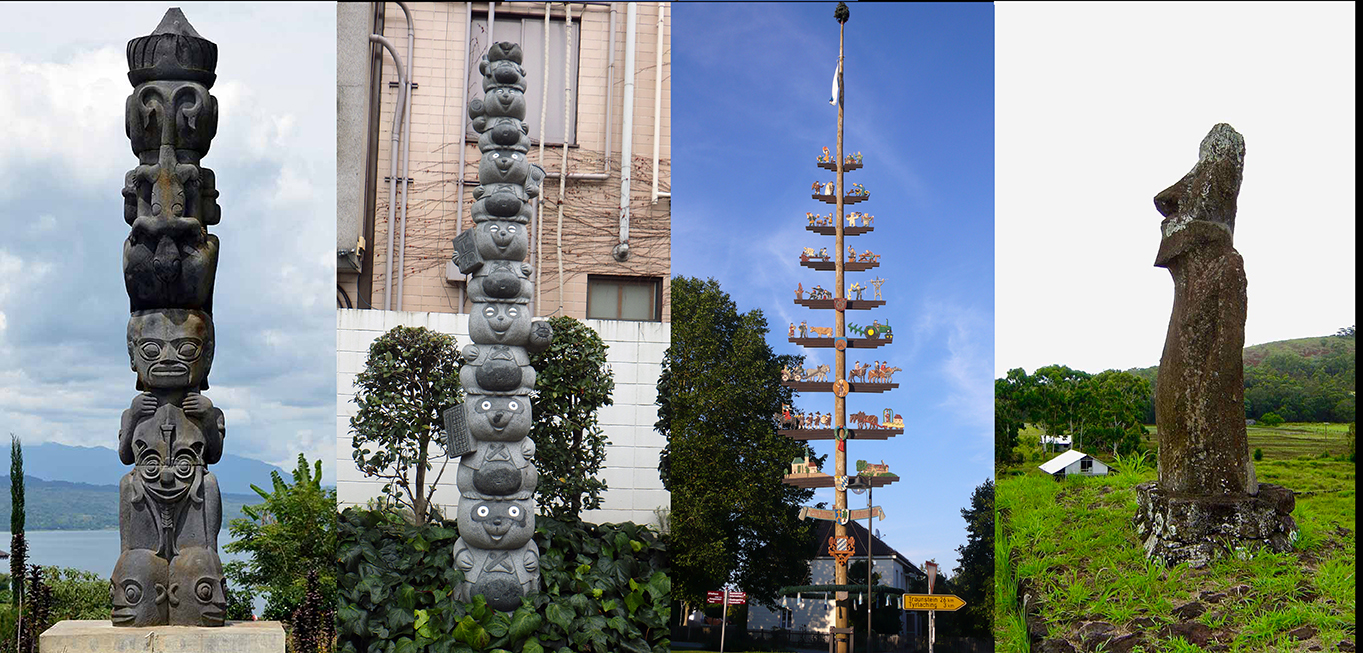
From museum bee to totem.
Naturalis’s collection box, 28,000 photos at TU Darmstadt and a 3D print, layer by layer: this is how a bee becomes the artwork on top of the totem.
Keep reading


From reading to planting.
Find the bee that belongs to your neighbourhood, and plant her flowers.