What is RefuBees / Art and science
Art and science
Totemism
Totemism: ancient practices and modern art
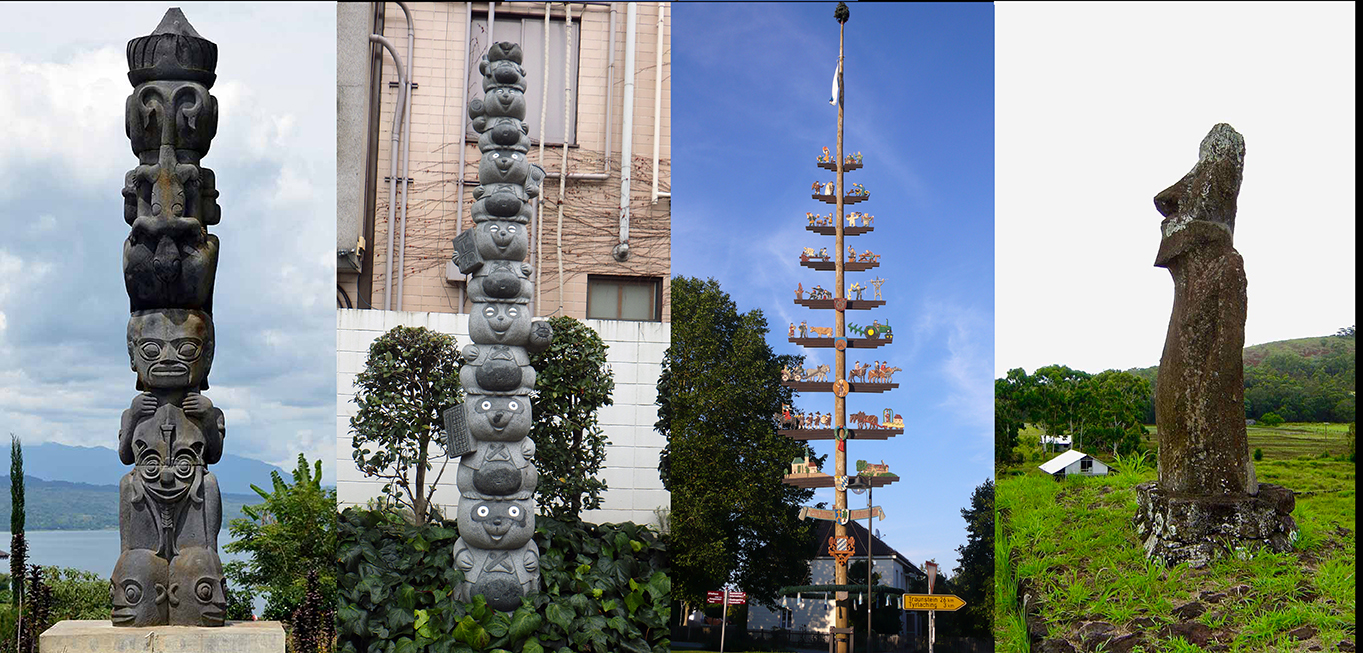
Hans Kalliwoda’s doctoral research also focused on totemism, an ancient pagan practice known for its ability to create strong communal bonds. Over the past tens of millennia, totem traditions within different cultures around the world have undergone varied and dynamic transformations. These transformations have produced a rich tapestry of variations in both the visual and the performative dimensions of totemism, the latter encompassing various ritual aspects. Despite the remarkable diversity of these expressions, one common thread runs through all of them: the ability to bring about social cohesion.
Totemism as an innovative method within the framework of social sculpture
Kalliwoda’s artistic endeavours have led to the development of innovative methods within the framework of a social and dynamic sculpture. These sculptures go beyond the conventional notion of a mere “street object” and transcend the conventional framework of art in public space by actively involving residents and making them owners and custodians of the artwork. A hallmark of this unconventional approach to art is that it is intercultural and welcomes people regardless of their faith, cultural background or age group. It is also low-threshold, so that it can be embraced by a broad and diverse audience, which in turn promotes unity and integration.
A new look at the origins of totemism
Kalliwoda has set himself the aim of reinterpreting and adapting the concept of totemism, which has always fascinated him. He argues that the precise origin of totemism is uncertain and may go back to the time when cave paintings were made. This origin, however, probably lies in a pre-religious period when human societies were described as “pagan”. In this time the spirituality and belief systems of these pagan societies were strongly influenced by natural phenomena and there was a strong sense of connection with nature. In this context it is remarkable that traces of these ways of thinking have survived to this day among the various ethnic groups.
The connection between humans and nature
By contrast, “modern” organised religions have often promoted the idea that humans are separate from nature, and even stand above the natural world. These ideas and approaches, which are part of a sort of hyper-individuality, have persisted to this day. Although many ideas from the Renaissance reinforced anthropocentrism (thinking from the human point of view), there were also critics of this perspective. Some thinkers disputed the assumption that nature exists only for the benefit of humans. The philosopher Jean-Jacques Rousseau stressed the importance of a responsible approach to the environment and argued, from an ethical perspective, for a more harmonious relationship between humans and nature.
Function and interpretation of totemism
When one looks at the historical perspectives on this phenomenon at a scholarly level, one comes across a spectrum of interpretations, concepts and hypotheses. In his work on totemism, Frazer, for example, emphasised the function of solidarity that brings people together in social groups. He suggested that totem species function as repositories for the soul. Later he proposed the economic basis of totemism, based on the Intichiuma rites of the Aboriginal people of the Central Desert in Australia. Freud incorporated totemism into his psychodynamic analysis of cultural and religious forms and linked it to Oedipal guilt and the murder of the primal father. Arnold van Gennep and later Claude Lévi-Strauss continued the debate. Lévi-Strauss in particular criticised the concept of totemism and reduced it to a mere classification system without a substantive analogous relationship between totem and social unit.
Totemism in practice
In practice, totemism means symbolising social groups through natural species. It can range from universal systems that encompass all aspects of experience to specific assignments of traits or characteristics to individuals based on their totem affinity. Totem symbolism is often part of broader cosmological systems and has the capacity to confer meanings and identities on social groups that go beyond simply sticking a label on them. In some Indigenous cultures, for example, a particular animal may be seen as a totem symbol of a particular tribe or community. This is more than just a symbol: it reflects the beliefs and values of the community and gives them a sense of identity and connection with the natural world.
Parallels with the Bavarian and Austrian Maibaum:
Cultural symbols and community
A “Maibaum” in southern Germany, known in English as a maypole, is related to totemism in that it shares a number of thematic elements, in particular the use of symbols, community ties and the connection with nature. It is a cultural custom that reflects the values and identity of the community that erects it, just as totemism reflects the values and identity of the groups that practise it. In almost all communities there are still guilds today that often maintain certain customs and traditions, thereby preserving the importance of the crafts in the community. Maypoles bearing guild symbols can therefore also stand for the passing on and preservation of these traditions. It is important to stress that the symbols on a maypole are very individual and often depend on the history and traditions of the region or community concerned.
In short, totemism, which is often associated with “primitive thinking”, is a complex cultural phenomenon with an intricate interplay between concrete images and abstract references, in which different societies choose symbolic differentiation through natural species or other means, depending on their social structure. This choice has nothing to do with primitiveness, but is an expression of the complementary relationship between social form and symbolic variants.
Keep reading


From reading to planting.
Find the bee that belongs to your neighbourhood, and plant her flowers.