Essay · Landschap · short version
The city as a pollinator refuge
While insects are disappearing from nature reserves, the number of wild bee species in Amsterdam is rising. What does that mean for the city?
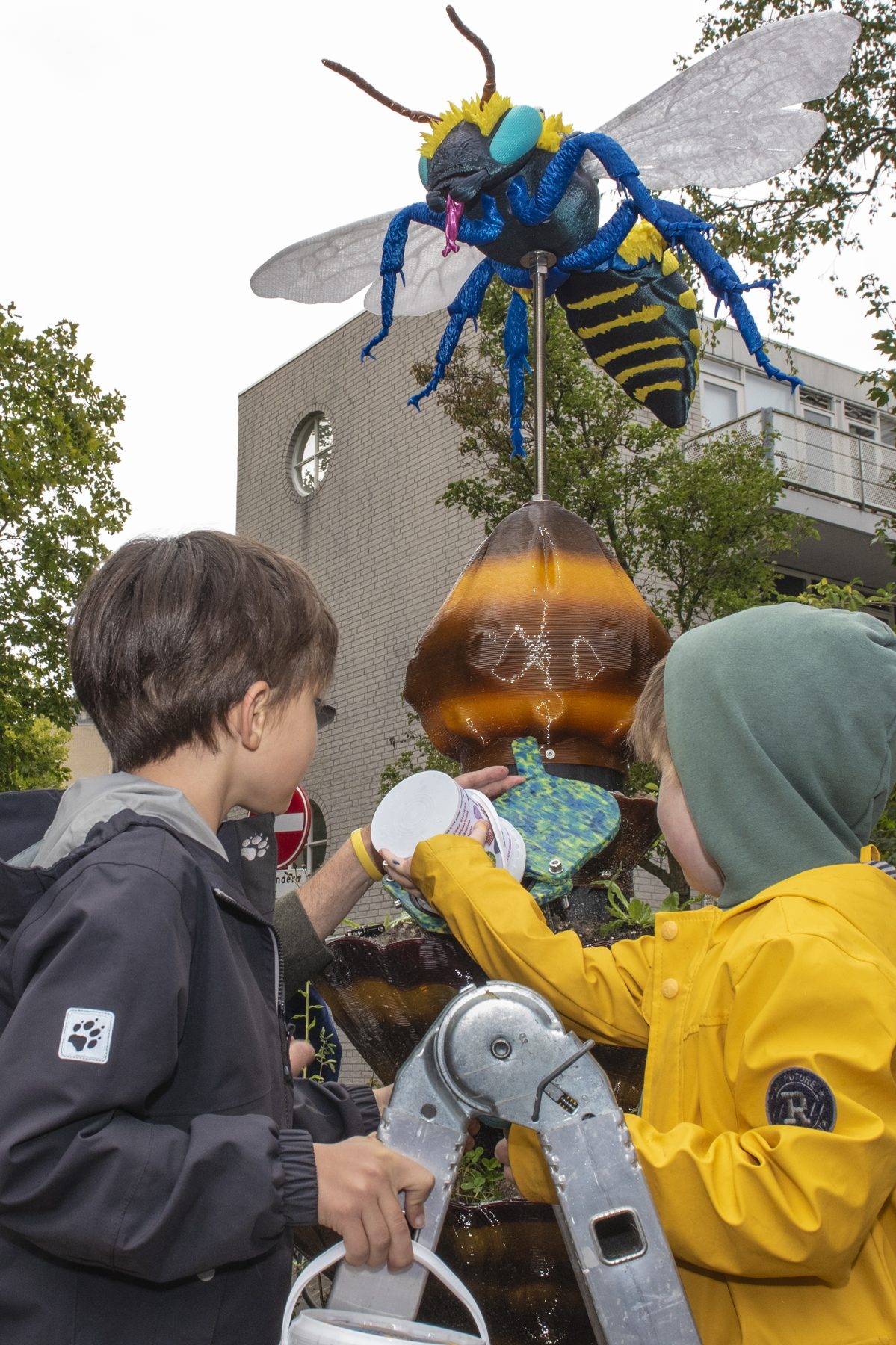
For years we thought that nature had to be protected outside the city and that the city was the problem. But in the same period that the quantity of flying insects in German nature reserves fell by more than three quarters, the number of wild bee species in Amsterdam rose from about 45 to well over a hundred.
This is partly because cities use less poison and mow less intensively. So in the city something arose that was becoming ever rarer outside: a mosaic of food without constant chemical pressure.
From more green to distribution
Wild bees fly only 100 to 300 metres. More green therefore does not help them automatically: what matters is that the right plants and nesting sites lie within their reach, species by species. This is called distribution policy.
In Amsterdam the city has been divided into 104 zones for this purpose, each with its own bee species and its own BeeTotem.
The open question: water
Could cleaner water in the city, from rain barrels, gutters and courtyard gardens, also be an explanation? This has not yet been investigated.
In brief
Why is the city doing better?
Less poison and nitrogen, and perhaps cleaner drinking water from gutters, rain barrels and puddles. That last point is an open question, not an established fact.
Key points
- More than half of the Dutch wild bee species are on the Red List.
- Amsterdam: about 45 species around 2000, more than 100 with longer measurement series. This concerns species, not numbers of bees.
- In 65 protected German nature reserves, the quantity of flying insects fell by more than 75 per cent between 1990 and 2017.
- Every year Amsterdam plants and sows about 70,000 m² of poison-free greenery.
- The EU Nature Restoration Regulation: the decline of pollinators must be halted by 2030 at the latest.
Source: H. Kalliwoda, The city as a pollinator refuge. Distribution policy and the hydrological blind spot. Landschap journal, to appear 2027.
From reading to planting.
Find the bee that belongs to your neighbourhood, and plant her flowers.